One trust found £47,000 in duplicate licensing. Another discovered 34% of their assets wouldn't survive an insurance claim. What's hidden in your records?

Your asset register already contains every answer your board will ask. Insurance gaps. Replacement cliffs. Duplicate spend. Compliance exposure.

The data exists. You just can't see it yet.

Actual findings from existing records

These are from trusts ranging from 4 to 23 schools, across inner London, Yorkshire, and the Midlands. Most had recently passed audits and considered their asset records complete.

£47,000
Duplicate software licensing across 8-school MAT. Same vendor. Different purchase orders. Annual waste.
The register was complete. The cross-reference wasn't.
34%
Assets with incomplete serial numbers. Insurance claim would fail verification on £220,000 of equipment.
Fields looked populated. Data quality wasn't there.
12_months
Window when 60% of ICT equipment reaches end-of-life. £180,000 replacement cost concentrated in single budget year.
Individually sensible purchases. Collectively a budget cliff.
0_audits
Number of times these issues showed up in operational reporting before we looked.
Your system doesn't alert you to problems it can't see.
What we actually do

Asset registers store what has been entered. They don't translate that into the intelligence your board needs.

We conduct remote diagnostics on your existing data — cross-referencing against insurance requirements, lifecycle norms, procurement patterns, and compliance baselines.

One way to think about our Leadership Report is as a financial X-ray for your asset estate. It reveals what's beneath the surface of your spreadsheets.

Board-level risks typically include
  • Insurance claim rejection scenarios (missing serials, unverified values)
  • Concentrated replacement spend in single budget year
  • Duplicate procurement across academies (same contracts, different rates)
  • Compliance gaps affecting audit outcomes
  • Estate condition liability for new academy acquisitions
  • Capital smoothing opportunities (how to distribute replacement across years)

Comprehensive Leadership Report. Written for CFOs and trustees. Fast turnaround.

We already have an asset register system.

So do the trusts in the evidence section. This doesn't replace your system. Your register stores the data. We explain what the data means for insurance confidence, capital planning, and financial risk. No integration. No rollout. We work with whatever export you already produce.

What if our data is incomplete or messy?

We work with imperfect data. Missing fields, inconsistent formats, incomplete records — that's normal. We flag data quality gaps as part of the analysis. The report shows both what your records reveal and where they're weak. That's often the most valuable insight.

What the output looks like

Before commissioning, most CFOs want to see actual output quality. Reasonable.

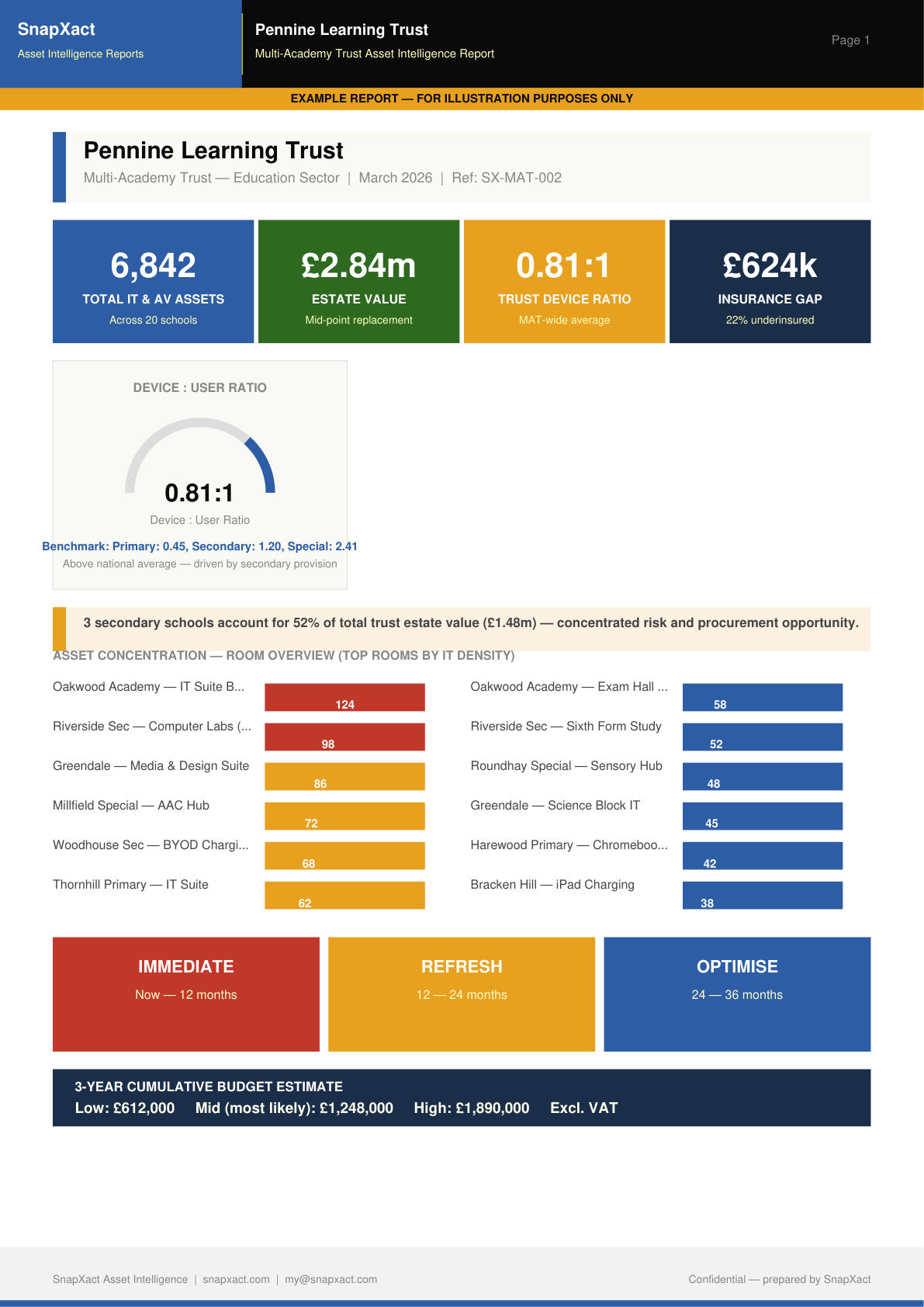
Leadership Report page 1 - Executive Summary

Executive summary — total estate value, insurance gap, replacement pressure

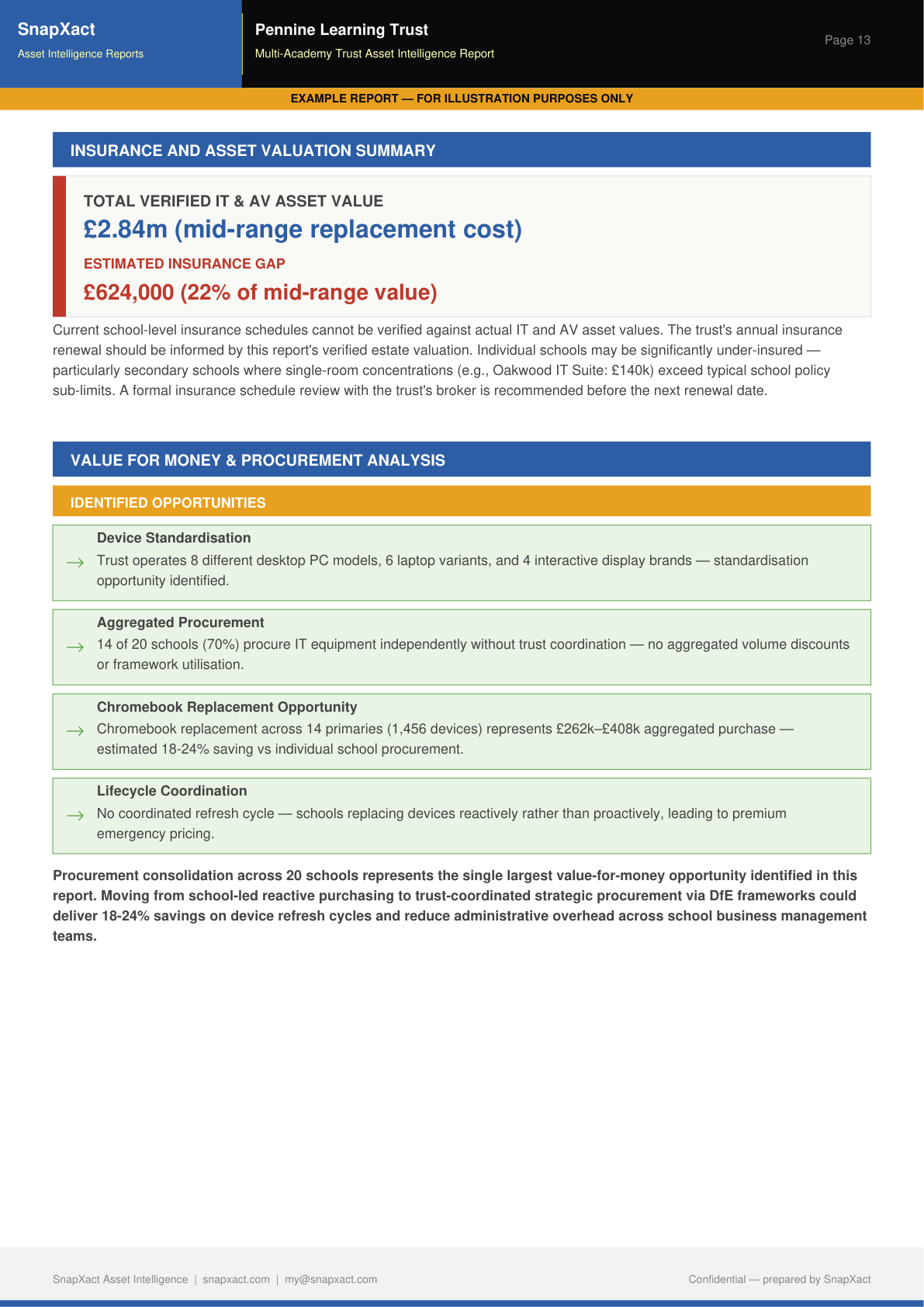
Leadership Report page 13 - Insurance Analysis

Insurance analysis — quantified exposure and valuation mismatch

open_full_sample_pdf →

How it works

Remote diagnostics. No site visits. No disruption. Fast turnaround.

  1. 01.
    You export the data
    CSV, Excel, or temporary read-only access. Whatever format you already use. We don't need credentials that touch financial or pupil systems.
  2. 02.
    We run remote diagnostics
    Cross-reference against insurance requirements, lifecycle benchmarks, procurement patterns. Surface exposure and blind spots.
  3. 03.
    You receive the report
    Board-ready output. Fast turnaround. No site visits. No disruption. No commitment.
Common concern

Most trusts worry their data isn't "clean enough" to analyze. It doesn't need to be. We work with real-world asset registers: missing fields, inconsistent formats, incomplete records. We flag data quality gaps as part of the analysis. That's often where the most valuable insights emerge.

Return on investment

Most trusts that commission this recover the cost through a single finding. One duplicate contract. One insurance gap closed before renewal. One procurement consolidation.

Typical ROI pattern

The median trust uncovers findings worth 15-40x the report cost within the first review. Financial waste, insurance exposure, or replacement pressure that operational reporting never surfaced.

Some find nothing material. Most find enough to justify annual reviews. A few find issues that change capital planning entirely.

One-off engagement. No subscription. No software. No dependency.

This is often commissioned around insurance renewal, audit preparation, trustee scrutiny, or capital planning cycles. Some trusts start with a single school to assess output quality before scaling trust-wide.

Finance directors typically request this during insurance renewals or ahead of audit cycles. Some CFOs use it to brief new trustees on estate condition without site visits. Operations directors commission it before capital planning rounds to surface replacement pressure early. It's becoming standard practice in trusts that take asset intelligence seriously.

Request report

We'll reply within 24 hours with data submission instructions and delivery timeline.